

ARMENIA: THE CRADLE OF CIVILIZATION
T H E C O S M I C C Y C L E
Written by Gevork Nazaryan
As we noted the recent sensational discoveries at Göbekli Tepe by the European archaeological team [published in the August 2000 issue of the German scientific magazine Bild Der Wissenschaft] showed that architectural structures, including such advanced complex manifestations such as temples and palaces, and for the time period [9th millennium BC!] very elaborate carvings and sculptures that adorn the cult temples and are in the vicinity of the historic site are carbon dated to 9, 000 BC -- that is -- 11,000 years ago! The article in the prestigious scientific magazine entitled 6,000 Years before the Pyramids! describes in detail the world's oldest temple located in historic Armenia. In addition to these very important finds, the recent sensational discovery of the Temple City in the Aragatsotn Marz of Armenia, by a team of archaeologists from the Academy of Sciences was astounding. The Temple City covers dozens of acres of land and the archaeologists have estimated that it will take about 30 years to fully excavate the whole complex. While exploring the rocks in the canyon of the river Kasakh a group of Armenian and French archaeologists found a monument from the Mesolithic era [Epipaleolith] quite unique for the Caucasus and Near East. The excavations were led by Boris Gasparyan, the head of the archaeological team from the Institute of Archaeology and Ethnography of the National Academy of Sciences of Armenia.
Another group is examining the rock paintings found in the cave Geghamavan I,
1 km of the Kmlo caves. The unique paintings are in ochre - a substance said to
be used only in late Eneolith and early bronze (IV-III). Meanwhile the
Geghamavan I paintings date back from the Neolith. The Neolithic man of Gheghama,
Syunik and Aragats had already mastered the linear drawing technique. The
paintings depict various animals most prominently deer. The findings have shown
that the rock painting traditions widely presented in the mountains are older
than they were thought to be.
Found in the Kmlo caves near the village of Apna, of the Aragatson region, were
not only fragments of obsidian tools but also a wild wheat grain dating back
from a period 10,000-8,000 years ago. The dating confirmed that the grain
samples are the oldest found throughout the region's Mesolithic monuments that
are carbon dated to 11,000-10,000 BC.
These promising new discoveries add to the important
findings of Metsamor that revealed the
earliest metal smelting foundries of the ancient world. In
the November 2003 issue, the prestigious scientific magazine Nature
published an article by scholars Dr. Russell D. Gray and Dr. Quentin D. Atkinson
[11.27.2003] verifying the origin (13 years after the publication by the
Scientific American of Indo-Europeanist linguists -- Dr. Vyacheslav Ivanov's
and Dr. Thomas Gamkrelidze's detailed work on the origins of The
Indo-European Language and the Indo-Europeans firmly established that
Armenia is in fact the Indo-European Homeland. This was further proved by the
Indo-Europeanist scholars who come to the conclusion of the Indo-European origin
in the Armenian Plateau and the immediate nearby areas by using
the empiric method based on the "analysis of a matrix of 87 languages with
2,449 lexical items produced an estimated age range for the initial
Indo-European divergence of between 7,800 and 9,800 years BP. These results were
robust to changes in coding procedures, calibration points, rooting of the trees
and priors in the bayesian analysis...the finding hints that
farmers in -- what is now Turkey -- [and is in fact historically,
ethnically and linguistically Indo-European Armenia - Mitanni - Armenian
Plateau. HOLY ARARAT is also today in "what is today Turkey" -- historic Armenia
cleansed of its native population through a horrific Genocide -- nevertheless
ARARAT will eternally stand for Truth, for Armenia and for the Armenian
people...] drove the language boom - and not later Siberian horsemen, as some
linguists reckon." [read more about these very important
finds in the November 2003 issue of Nature magazine].
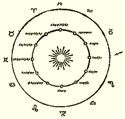
The Armenian Zodiac Wheel
12 Signs around the Sun
By the fifth millennium BC, Armenians combined sun worship with sophisticated
astronomy. They are now credited with assigning the constellations of the zodiac
their design and names, and creating one of the first solar calendars based on
365 days in the year. Also, around the fifth millennium BC a series of Vishaps
-- Dragon Stones, began to be erected on mountainsides throughout Armenia, near
water sources. At first resembling the sacred fish-God [dragons in Armenian were
thought to be huge fishlike creatures] the monolithic stones were later carved
with snakes, the heads of beasts, swastikas and crosses.
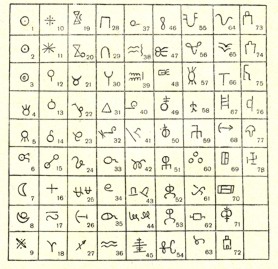
Armenian Hieroglyphs
Rick Ney,
multi-media complete guide of Armenia [see Tour Armenia Central --
tacentral.com], wrote about the phenomenal findings of Karahundj [translation --
Stonehenge... however, -- thousands of years older that the henge in England]
Armenia, contains some of the most
significant cultural examples of sacred geometry. Who were the first
astronomers? If proven true, a current controversial dating of the stones at
Karahundj predate England's Stonehenge, they predate the Babylonian's claim to
being the first astronomers, and they confirm what some people already suspect:
that Armenia is the birthplace of the zodiac, and perhaps the beginning of
navigation and the concept of time...It should be no surprise to anyone who
knows something of Armenia's history that astronomy is such an important part of
the national character. Sun symbols, signs of the zodiac, and ancient calendars
predominated in the region while the rest of the world was just coming alive,
culturally speaking. Egypt and China were still untamed wilderness areas when
the first cosmic symbols began appearing on the side of the Geghama Mountain
Range around 7000 BC. At Metsamor (ca. 5000 BC), one of the oldest observatories
in the world can be found...ancestral Armenians were indeed navigators, they had
an intimate understanding of the stars, how to plot latitude and longitude, even
how to divide time." [to read the rest of this valuable article by Rick Ney go
to -- astrologycom.com -- and search 'Armenia']. This means that the ancestral
Armenians had astronomical lists going back at
least to the Age of Leo. They developed the zodiac system and it clearly took
thousands of years of recorded observations giving plenty of time to find the
only logical starting point -- the
perfect defining point...
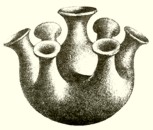
A Seven branched candle vessel from the Metsamor dig. Second
Millennium B.C.
Seven was the sacred number of the great Metsamor astrologers who among other
things associated the number 7 with the known planets [accordingly their
influences being septenary]. Later the Seven branched Tree of Life [that in
another earlier variant has has five branches or four + one] or the Cosmic Tree
in ancient Armenian representations evolved into a 9 branched Tree of Life
[symbolic of the nine planets].
On the Metsamor Hill a clay tablet with hieroglyphs belonging to the II millennium BC was discovered in 1963. Thus, it was established that before the appearance of the cuneiforms of Ararat, the inhabitants of the Armenian highlands used picture writing. And here is what is amazing: throughout the ancient world and up to our times, the designations of the twelve constellations of the zodiac almost completely coincide with the ancient Armenian hieroglyphs.
As the greatest historians of astronomy --
Mounder, Svarz and Flamarion -- considered that "the people who divided the
heavens into constellations, lived between latitudes 36 and 42
degrees North..." - the precise geographic axis of the Armenian Plateau. While
the English astronomer, W. Olcott, directly states that, in his opinion "the
people, who divided the heavens into constellations, in all probability lived in
the Euphrates Valley and also in the region of the Ararat Mountain."
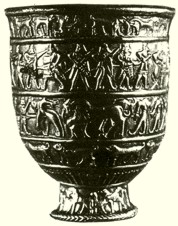
A DECORATED SILVER BOWL
HRAZDAN [HURASTAN -- LAND OF THE FIRE].
THIRD MILLENNIUM BC.