

THE LAST YEARS OF REIGN
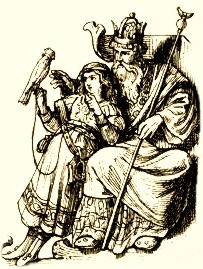
KING TRDAT III WITH HIS DAUGHTER
YOUNG PRINCESS -- THE FUTURE QUEEN
Written by Gevork Nazaryan
The establishment of the first Christian State did not bode well with the Romans, Persians and other still fervently pagan peoples. The Romans changed their policy of "divide and rule" in the face of growing Sassanian strength, as well as the growing menace from the Germanic tribes north of the Roman Empire. More and more Armenians were being invited and given posts as Roman generals, centurions and legionnaires, a trend that began as early as the first century AD. This led to the establishment of numerous, strong Armenian feudal, aristocratic houses in the Western and as well as Eastern [later Byzantine] Roman Empires. Also, the Armenians carried over with them the Armenian solar cult of Mithraism [the Orion cult] to the different parts of the Empire and to Rome itself. The Sassanians launched an all out attack in the hope of retaking Armenian Mesopotamia and Atrpatakan. King Trdat III led his army into the four outpost bdešxut'iwns [military marks] throughout the four cardinal directions of Greater Armenia, strategically established by Artaxerxes I in second century BC. The Sassanian army was successfully checked and thrown back to the frontier. Meanwhile the numerous tribes of Caucasus began raiding the northern and northeastern Armenia. Trdat with the help of his brother-in-law, the King of Alans led a number of punitive campaigns against the raiders. The Sassanians, unable to subdue Armenia by the means of arms, sent assassins in order to kill the King. In 330 King Trdat III was poisoned during a royal feast during a countryside visit, in the province of Daranałeac‘. The King's body, according to the royal tradition was placed in a silver casket and was buried in the Royal Arsacid cemetery of T‘ordan. His shrine became a site of pilgrimage for the King's subjects.
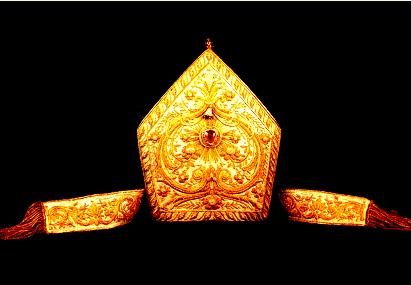
THE TRADITIONAL CATHOLICOSAL/PATRIARCHAL MITRE [MITHRAS] IN THE
FORM OF
A PENTAGON WAS IN CONTINUATION OF EARLIER NATIONAL HERITAGE
OF THE SYMBOL OF EA [SPLIT FISH TAIL]. THE EIGHT POINTED
CROSS [FOUR FOLD WITH 'FISH TAILS' MALTESE CROSS
COMING TO EIGHT POINTS...
LEADING TO THE CENTER -- NINTH POINT -- ENNEAD].
NOTE THE RED RUBY WITH THE SUNBURST IN THE CENTER,
THE APEX OF THE MITRE IS CAPPED BY THE PATRIARCHAL CROSS.
ARMANI MITHRAIC CONIC DOMES UNITED THE TRIANGLE AND THE SPHERE...
[MALE + FEMALE UNION].
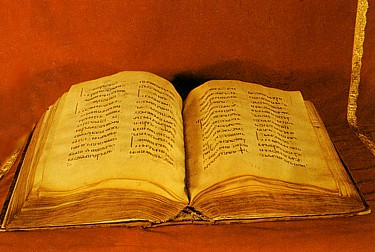
ARMENIAN SACRED BOOKS METICULOUSLY WRITTEN AND ILLUMINATED.
THE LOVE FOR BOOKS AND KNOWLEDGE IS PART AND PARCEL OF
ARMENIAN CULTURE.
Edward Gibbon noted that "In Armenia, the renowned Tiridates had long enjoyed the peace and glory which he deserved by his valour and fidelity. By the Conversion of Tiridates the character of a saint was applied to that of a hero, the Christian faith was preached and established from the Euphrates to the shores of the Caspian"
[History, Vol. II., p. 368]. King Trdat III was canonized by the Apostolic Church. Trdat
III along with St. Gregory are important figures that led to the establishment of
Christianity not only in Armenia but throughout the world.