REUNIFICATION
'The causes of events are ever more
interesting
than the events themselves.'
-- CICERO
Written by Gevork Nazaryan
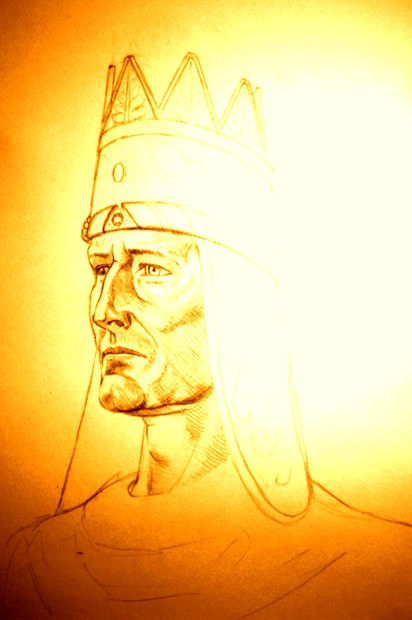
After the death of his father in 96 BC, Tigran agreed to hand over the Seventy Valleys, located in Southeastern Armenia [most probably somewhere in Armenian Atrpatakan or Atrpatenē] in exchange for his return and coronation as the new King. Prince Tigran was crowned in 95 BC, as the new monarch -- Tigran II. From the first days of his ascendance, Tigran rapidly began to rebuild and reorganize every aspect of socio-political, economic, as well as military life. The highly energetic and ambitious King established a new order throughout his domain. He created a standing army of 100,000 men, -- the nucleus of which was the legendary Armenian cavalry compromised of the the aristocratic Azats or the Freemen. Tigran II also formed alliance with the neighboring peoples and kingdom that included the Georgians, Adiabenians, Caucasian Albanians, Atropatenes, Cappadocians, Gordeyenes [Armenians of Korduk'].
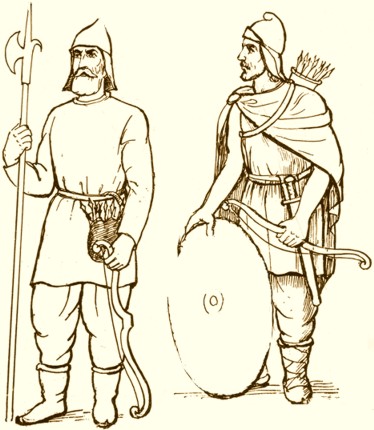
ARMENIAN FOOT SOLDIERS WEARING THE TRADITIONAL MITHRAIC CAPS.
W H I T E TUNIC/TROUSERS WITH R E D CAPE/HAT.
UNLIKE THE MOUNTED AZATS [LOWER ARISTOCRACY], THE FOOTMEN
WERE NOT ARMORED LIKE THE ELITE CAVALIERS. NEVERTHELESS THE
FOOT SOLDIERS, WHO WERE MADE UP OF THE MSHAKS [COMMON FOLK], WERE JUST
AS FIERCE WARRIORS LIKE THE NOBLE AZATS WHO CAME FROM
A MILLENNIA TRADITION OF A FREEDOM LOVING FIGHTING SPIRIT.
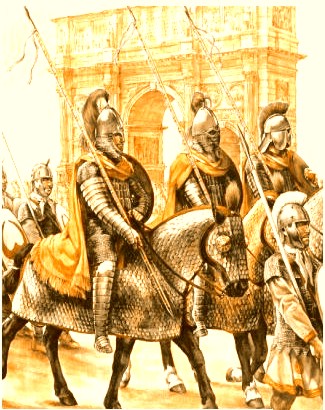
THE WORLD RENOWNED ARMENIAN CATAPHRACTS [HEAVILY
ARMED AND ARMORED] OF THE AYRUDZI MADE UP
THE CORE OF THE IMPERIAL ARMY OF THE KING OF KINGS.
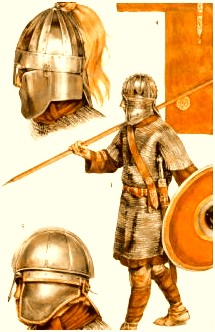
LOWER AZAT [MINOR NOBILITY] ON FOOT OR MOUNTED NOTE THE ARMENIAN
HELMET WITH HORSE-HAIR ['PONYTAIL'] STANDING FOR THE
SACRED STEED THE VERY SYMBOL OF NOBILITY/CAVALIERS.
THE TAIL ALSO STOOD FOR VIŠAP/DRACO/DRAGON
ANOTHER SYMBOL
OF THE MILITARY SYMBOLICALLY REPRESENTED AS A DRACO BANNER.
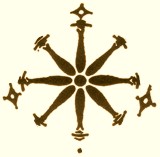
8 - P O I N T E D
M I T H R A I C S T A R O F V I C T O R Y
T H E G U I D I N G L I G H T O F
T H E K I N G O F K I N G S
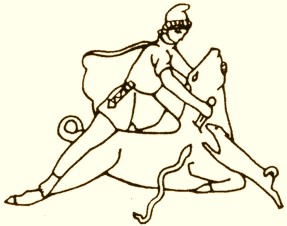
S O L
I N V I
C T V S
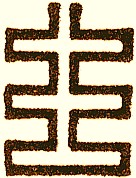
ANOTHER VERSION OF THE SACRED MITHRAIC SYMBOL [WITHOUT THE DOT] OF
ARTAXIAD SOLAR KINGS [CONTINUED THE ORONTID - ORIONTID ROYAL BLOODLINE.
TWO UNITED 'E's FACING EAST AND WEST ON ONE SINGLE STEM.
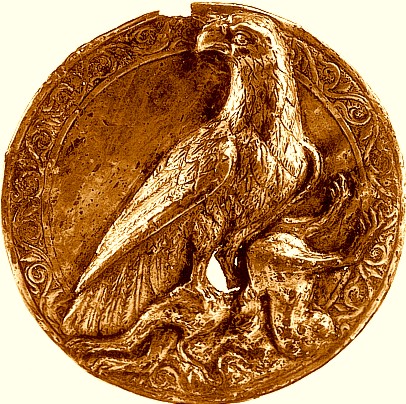
SILVER GILDED SOLAR MEDALLION OF AN EAGLE
CLUTCHING A LEOPARD. THE EAGLE WAS AN IMPORTANT ARTAXIAD INSIGNIA
SYMBOLIZING THE CELESTIAL REIGN OF THE SUN [AND ITS MATERIAL EMBODIMENT --
THE KING] OVER THE LAND. SECOND OR FIRST CENTURY BC. SISEAN, SIWNIK‛
PROVINCE.
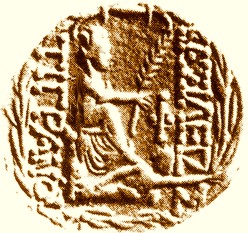
THE GREAT PATRON GODDESS ON THE OBVERSE SIDE OF THE IMPERIAL
COINS
OF THE KING OF KINGS. IN HER LEFT ARM THE HOLDING THE STEM OF FERTILITY/LIFE
AYA [EYE] -- YSE -- I-SIS. GRAIN/WHEAT STANDING FOR THE
SACREDNESS OF
SOIL AND MOTHER ARMENIA.
BELOW IS THE RIVER GOD CETUS/ORONTES [ORIONTES] CONNECTED WITH
THE LIFE NOURISHING EUPHRATES [ONE OF THE FOUR RIVERS OF PARTEZ-PARADISE]
THAT ROSE IN THE SACRED HIGHLAND.
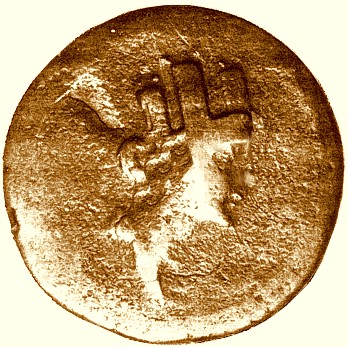
A N A H
I T. THE GREAT PATRON GODDESS
DEPICTED ON THE COINS MINTED IN CAPITAL ARTAXATA.
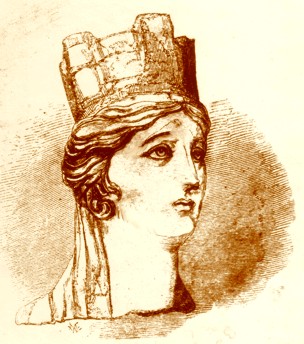
THE GOLDEN MOTHER GODDESS IN ALL HER BEAUTIFUL GRACE.
WITH THE RESTORED GOLDEN CROWN
[SEE THE BEAUTIFUL HEAD -- REMNANT OF THE
GLORIOUS STATUE OF THE GODDESS
ON DISPLAY IN THE BRITISH MUSEUM --
IN THE SUBSEQUENT PAGES OF THIS CHAPTER]
As the Vth century Armenian historian Mowsēs Xorēnac‛i -- the Father of Armenian History -- recorded in his Armenian History: "footmen became horsemen, the light infantry received armor and became armored infantry." Tigran united the military forces of the naxarars -- the high nobles -- into the Royal Army -- turning his newly built fighting force into a powerful, well trained and highly organized war machine. In Tigran' Army, strong devotion and loyalty to the military leadership formed the foundation. Strabo, the renowned Greek historian wrote: "When he [Tigran the Great] acquired power, he recovered these [seventy] valleys, and devastated the country of the Parthians, the territory about Ninus [Nineveh], and that about Arbela. He subjected to his authority the Atropatenians, and the Gordyaeans [Armenian nobles of the Korduk' Province] by force of arms he obtained possession also of the rest of Mesopotamia and, after crossing the Euphrates, of Syria and Phoenicia." [Strabo, XI.xiv.16]
But this was only the beginning in
the high ascent of one of the greatest Armenian military leaders in world
history. In 94 BC, in the wake of Roman expansion into western Asia Minor, Tigran
signed a treaty of cooperation and mutual defense with King Mithridates
Eupatores of Pontus, thus making that kingdom an ally of Armenia. In 93 BC, Tigran first of all focused on the Armenian province of Tsop'k'
[Sophene] on the eastern banks of river Euphrates in Western Armenia.
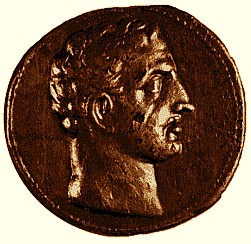
HANNIBAL BARCA: THE CARTHAGINIAN GENERAL'S
INGENIOUS MILITARY TACTICS
DURING THE PUNIC WARS HAVE MADE HIM A POPULAR ICON OF STUDY AND
EMULATION IN MANY OF THE MILITARY ACADEMIES THROUGHOUT THE AGES

G O D L I K E [G
O D H O O D] THE SACRED WORD [CHANT]
INSCRIBED ON THE GOLD AND SILVER COINS OF THE SUN KINGS.
9570400
The rulers of Tsop'k', claimed descent from the Royal Orontid [ORIONTID, the name for the Oriontes River that was placed on the gold [OR=GOLD-Metal of the Gods] and silver coins of the Sun Kings and the word ORIENt and ARYAN also comes from O R I O N] House [Ervanduni], the dynasty that preceded the Artaxiads in their rule of Armenia. The Ervandunis were still the ruling monarchs of Lesser Armenia or Armenia Minor [situated on the western banks of Euphrates, in the vicinity of the ancient Armenian Kingdom of Hayasa-Azzi]. The Ervanduni Royal House was overthrown by one of its own representatives -- Prince Artaxerxes in 189 BC. Artaxerxes or Artašēs established the new dynasty that followed the Orontid House. He made a number of economic reforms in order to stimulate agriculture and trade. Artašēs was able to unite and centralize the monarchy [something that the Ervandunis were never able to fully achieve], by bringing in line the often unruly naxarars or the high nobles who wanted de-centralization in order to secure more rights for their own individual provinces. Greater Armenia included 15 ašxarhs or provinces [17 if we include Armenian Mesopotamia and Goderdzakan ašxarhs] with a divisions of 120 gavars or counties. According to a number of Greek historians the strategic location of the royal city of or Artašat or Artaxata -- lit. Joy of Artašēs -- [166 BC], on the banks of river Erasx (Arax) was chosen by the great Carthaginian Commander Hannibal Barca [247-182 BC], who was an honored guest at Artašēs' court. According to the Graeco-Roman primary sources, the Carthaginian commander, after leaving his campaign in the Italian peninsula departed to Armenia. Artašēs and Queen Sat'enik [Alani Princess] were the grandparents of Tigran the Great.